📍 Malmö, Sweden · September 14–16, 2026
40% of of Horizon Europe abstracts now show AI use.Overreliance on AI text is linked to lower scores.
— JRC Working Paper 02/2026, European Commission
Here is why — and what to do instead.
◆ Limited to 20 Organisations
Join the 3-day AI Project Writing Intensive.
Most training tells you how to write (you already know that).
In 3 days, you reclaim your power — using a methodology developed across 25 years of international project proposals writing, applied to your specific call, with 20 organisations in the room.
You arrive with an idea.
You leave with a finished, evaluator-ready draft.
76%
first-submission approval rate
(KA220, 2023–2025)
Stop guessing what evaluators want.
26
strategic steps
Total structural clarity. Relief from months of drafts.
20
organisations
Your draft, plus partnerships with top-tier organisations. Build a reliable network.
Payment only after workshop confirmation · Limited to 20 participants

“The problem is not AI.
The problem is how it is used.”
Igor Razbornik · 25+ years of project writing · 37 cohorts
Joint Research Centre · Working Paper 02/2026 · Santoleri, Rentocchini, Lelli
By end of 2024, 40% of Horizon Europe proposals showed detectable AI-assisted writing. Those proposals received lower evaluation scores, were less likely to meet the quality threshold, and less likely to receive funding.
The problem is not AI. The problem is how it is used.
Most project writers use AI
at the wrong stage.
The standard approach: write a short concept note — two pages — then ask AI to expand it into a full proposal. This produces smooth text built on thin thinking. AI cannot invent. It can only expand what is already there.
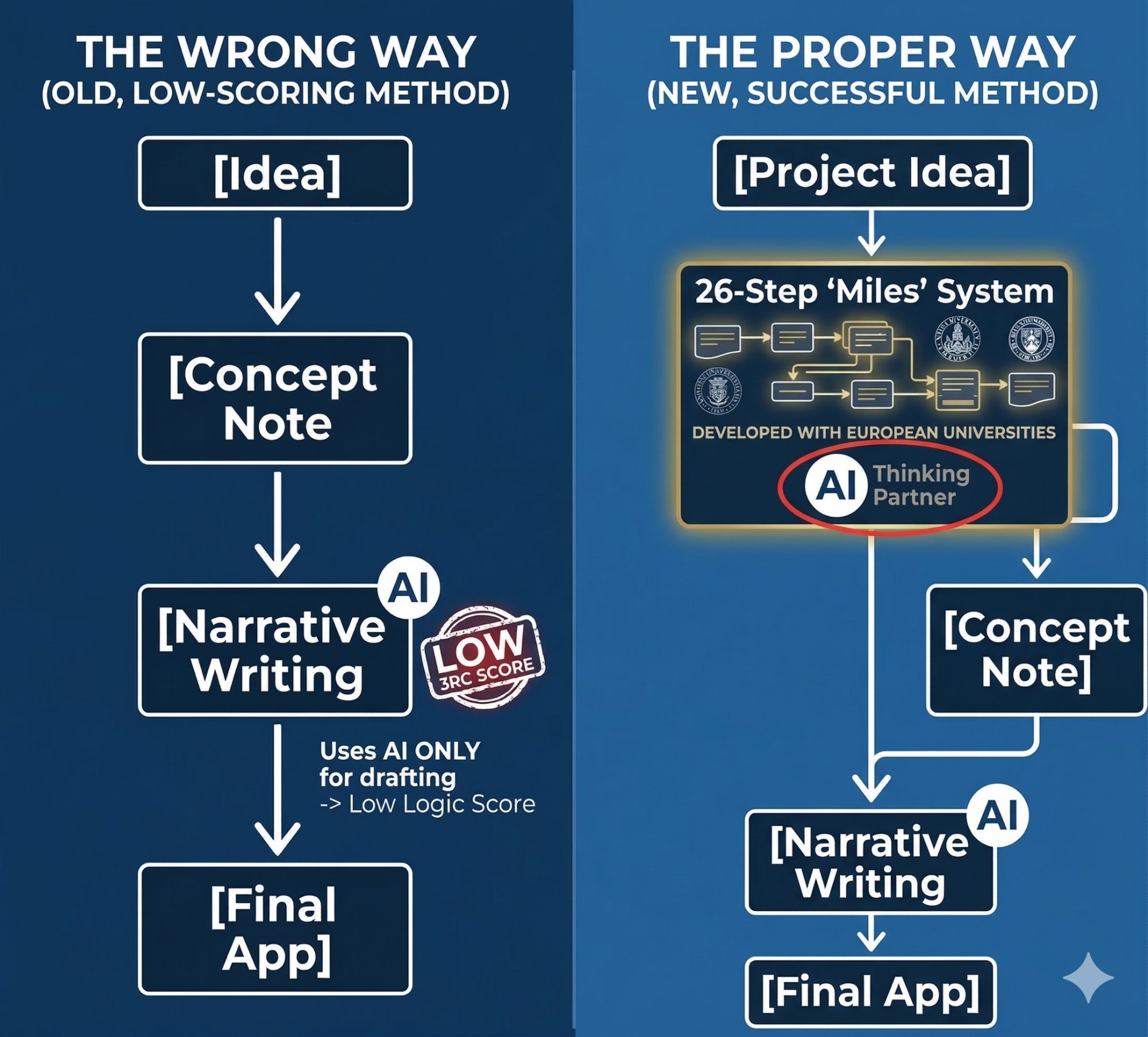
This is the most common workflow among experienced project writers. It worked at 82 points. It does not work at 92.
What you are buying
Incubator:
Everything you get
in three training days.
Three days in a room in Malmö
A live, in-person working session with 20 confirmed project opportunities. Not a webinar. Not a course.
A complete project draft
By Day 3 you have a real, evaluator-ready draft built on your specific project idea.
Miles
The AI system you use during and 30 days after the training. It runs the 26-step methodology. You do not need to know the steps.
The WinCode methodology
26 steps built over 12 years that give your project idea the logical architecture evaluators reward.

Your AI thinking partner
Miles doesn't write
your proposal.
It sharpens your thinking.
Miles is not ChatGPT with a project writing prompt. Before it asks you a single question, it reads your call fiche. It identifies what your specific programme values, what your evaluators are looking for, and where most proposals in that context lose points.
Miles does not let you skip steps. Each step is confirmed before the next begins — because Step 12 is built on Step 10, which is built on Step 5. Miles knows it. It carries it. Your only job is to think about your project idea.
No blank page. No guessing what comes next. No writing a single sentence until your thinking is complete.
How does a conversation with Miles look like?
Miles works for any programme
30 days free access after training
You leave with a draft and a full month of Miles access to refine it section by section — at your own pace, in your own language.
The logic audit
Miles reads your proposal
the way an evaluator will.
Planning
Theory of Change
A map of why your project will work — from the problem diagnosis through the activities to the lasting impact. Miles checks that every link in the chain holds.
Impact Pathway
Does each activity logically connect to an outcome — and does that outcome contribute to your stated impact? Miles traces the pathway and flags broken links.
Behavioral Needs Diagnosis
Open-question surveys analysed by AI — not Likert scales. You discover what your target group actually thinks, not what you assumed they would say.
Design
Behaviour Change Logic
Have you diagnosed why your target group is not already doing what you want them to do? Miles checks that your activities address the actual barriers — Capability, Opportunity, Motivation.
Proactive Mitigation Strategy
Have you built your risks into the work plan — not just listed them? Miles checks that every identified risk has a corresponding activity, not just a note.
Most Significant Change Stories
Can you prove the change happened — not just that the activity occurred? Miles helps you define the evidence of real behavioral change before you submit.
Audit
What makes this project different?
Miles tests your uniqueness claim against existing funded projects in the same field. If a similar project already exists, you will know before the evaluator finds it.
Do we have firm needs analysis?
Miles checks whether your needs analysis is grounded in real evidence from your target group — not assumptions confirmed by Likert scales.
How sound is our implementation?
Step 26 runs the same scoring logic an evaluator uses. If Step 26 flags a gap — you fix it here, not in the rejection letter.
If you have written EU projects for years
This section is
specifically for you.
You know the structure. You know how to read a Programme Guide. You have written needs analyses, work packages, SMART indicators. None of that is wrong.
What changed is the threshold. Two years ago, a well-written concept note expanded into a coherent proposal was enough to score 88. Today evaluators are trained to distinguish between a proposal that was planned and a proposal that was written. The difference shows up in the logical connection between your problem diagnosis and your work package design — a connection that concept-note thinking does not produce, and that AI expansion cannot invent.
The 26-step methodology was built in 2013 specifically to solve this. Not to teach you what a work package is. To give your thinking the architecture it needs before you write the first sentence.
What evaluators are rewarding in 2026
The threshold moved.
Most project writers don't know yet.
88
points · 2 years ago
→
92+
points · effective threshold today
In several recent KA220 calls, the effective funding threshold has moved above 92 points — proposals that would have been approved two years ago are now on the waiting list.
Behavioral analysis, not needs description
High-scoring proposals explain why the target group behaves as they do — identifying specific Capability, Opportunity, and Motivation barriers. High-scoring proposals increasingly show behavioral analysis aligned with COM-B logic.
Outcomes, not outputs
The difference between a manual produced and a practice changed. Evaluators in 2026 are trained to spot this distinction. Proposals that don't make it visible lose points on impact criteria.
Quantified social return
SROI — Social Return on Investment — lets you express impact in concrete terms: euros of value per euro invested. SROI framing is appearing in proposals that score above 90 — and evaluators trained in behavioural impact assessment are increasingly rewarding it.
Observed across KA220 calls, 2024–2025 · Better Future Slovenia evaluation data
Who attends
Three types of professionals
come to this training.
📝
The experienced writer
You have been writing projects for years. Your workflow: concept note, then draft, then AI to speed up the narrative. Your last proposal scored well — but not funded. The methodology that got you to 82 points is the same one keeping you at 82 points.
🚀
The newcomer with a real idea
You have a clear problem to solve and an organisation ready to move. What you need is a structured process that produces a complete, evaluator-ready proposal — and partner connections that make it credible. You want to start correctly.
🔍
The evaluator or consultant
You assess proposals or advise on funding strategy. You want to understand how the new generation of project design works from the inside — how AI is being used correctly and incorrectly, and what separates 84 from 92.
⚠ Not the right fit?
If you are looking for an AI tool to write your proposal while you sleep, please do not apply. This is for professionals who want to work harder on their logic, not skip the thinking.
The system behind the results
The 26-step WinCode methodology.
76%
First-submission approval rate
KA220 participants who completed the full incubator process (Better Future Slovenia, 2023–2025). EC published baseline: 15–26%.
25y
International project writing
EU structural funds, Erasmus+, Horizon Europe, Interreg, US-AID, bilateral donors.
5y
Erasmus+ evaluation experience
Direct knowledge of how proposals are actually scored — not just what the guide says.
60+
Completed Erasmus+ projects
Methodology tested across different programmes, criteria, and funder expectations.
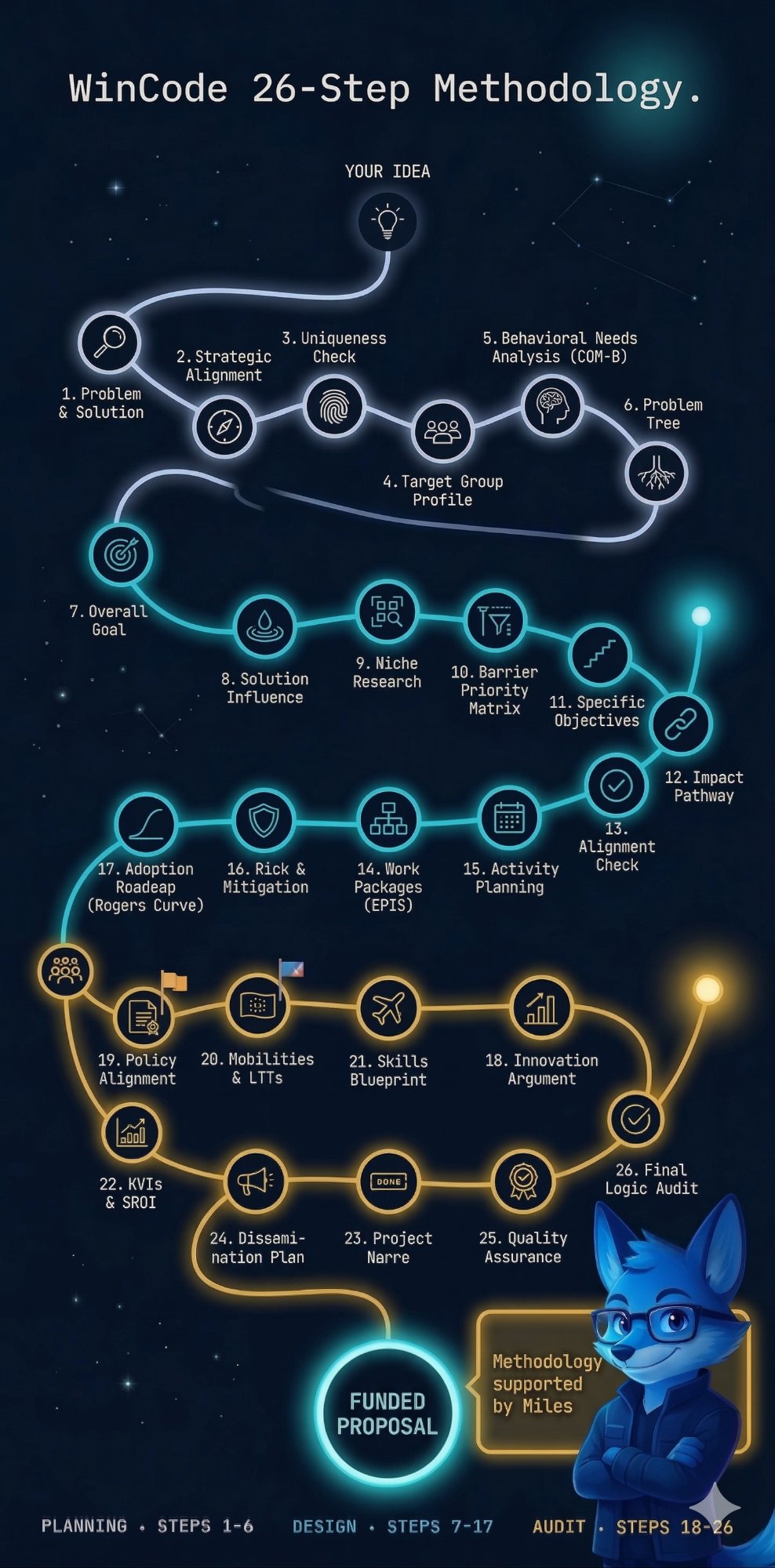
What happens in the room
Three days. One complete draft.
Four project opportunities.
You arrive with an idea. You leave with a complete, evaluator-ready draft — and three confirmed partnership involvements.
Day 1
Diagnosis
From problem description to behavioral analysis
- ●Why evaluation shifted from activity metrics to adoption metrics
- ●COM-B in practice: analysing your specific target group
- ●Behavioral Segmentation (Steps 4 & 5): beyond demographics
- ●The Behavioral Gap Map (Step 6): Current vs. Desired Behavior
- ●The Impact Pathway (Step 12): from input to behavioral outcome
- ●First working session with Miles
Evening — Project Pitching
Each participant presents in 3 minutes: the problem, the target group, what expertise they need. In a room of 20 organisations, the gaps fill quickly.
Day 2
Architecture
From analysis to intervention design
- ●Designing Interventions (Step 14): Work Packages as behavioral change mechanisms
- ●AI Co-Design with Miles: drafting and stress-testing activity logic
- ●Outcomes vs. outputs: what you produce vs. what changes
- ●Peer review: does your design solve the barriers you identified?
- ●Risk Management (Step 16): identifying unquestioned assumptions
- ●Key Value Indicators: measuring adoption, not attendance
Evening — The Bohemian Corner
Informal dinner where the real partnership work happens. Away from the agenda, over food and a drink, participants share what they are building, who they need, and what they can offer.
Day 3
Value
From good project to funded project
- ●SROI in practice: calculating the economic value of your project's impact
- ●Miles narrative audit: identifying vague language before the evaluator does
- ●The Innovation Argument (Step 18): methodology as a quality signal
- ●Key Value Indicators (Step 22): proving behavioral change, not just activity
- ●Final pitch: presenting your project to the room
After training — 2 online follow-up sessions
At 3 weeks and 6 weeks: review, refinement, and submission preparation.
The multiplier structure
You work on one project.
You leave with four.
Every participant develops their own project. But the structure of the three days is designed to make more than one outcome possible — most participants leave involved in four project opportunities.
Your project — A complete, evaluator-ready draft by Day 3
Partnership in Project #2 — Your expertise fills their gap
Partnership in Project #3 — Their network complements yours
Connection in Project #4 — Built from a conversation between sessions
🎤
Day 1 Evening — Project Pitching
Three minutes. Your idea. What you need. Who in the room has it.
☕
Between sessions — The Bohemian Corner
The informal conversations happen over coffee and dinner. "Your experience fits exactly what I'm designing." These become partnership agreements.
🤝
By Day 3
Same three days. Four times the opportunity.
The people in the room with you
Your trainers.

Igor Razbornik
Creator of the 26-step WinCode Methodology · EU Project Trainer · Erasmus+ Evaluator
Igor has been writing international projects for 25 years — across EU structural funds, Erasmus+, Horizon Europe, Interreg, and bilateral donor programmes. He has led more than 60 completed Erasmus+ projects.
His 5 years as an Erasmus+ evaluator give him direct knowledge of how proposals are assessed — not what the Programme Guide says matters, but what actually changes scores in a real evaluation panel.
AI was added later as a tool to support the methodology — not the other way around.
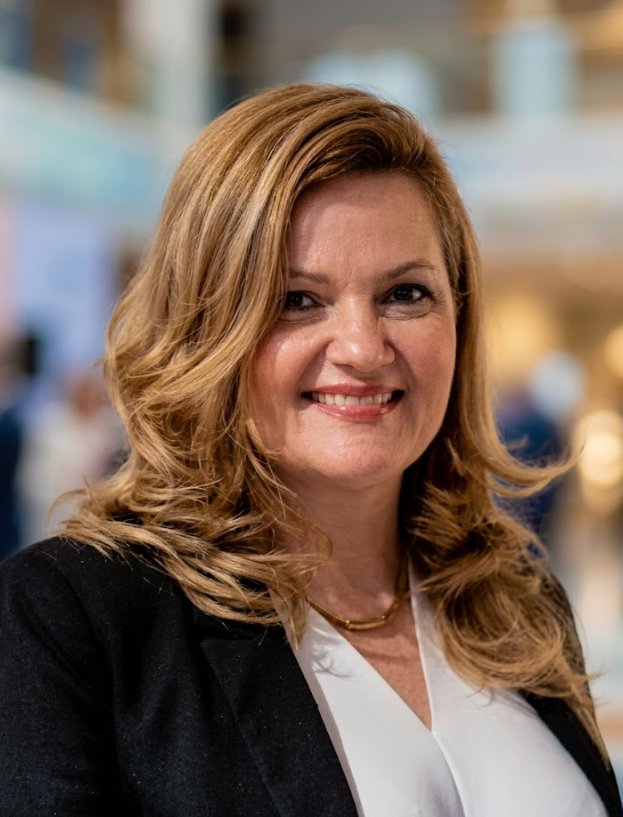
Sanja Todosijević
Co-designer of the Miles AI System · EU Project Trainer · Strategy Consultant
Sanja co-designed the Miles AI system and brings deep expertise in EU project strategy, proposal coaching, and partnership development. She leads the pre-training strategy conversations and the follow-up sessions.
In Malmö, Sanja manages the partnership structure — the project pitching, the Bohemian Corner, and the follow-up process — so that what happens in the room turns into active project partnerships.
The Bohemian Corner
Partnerships form over dinner,
not business cards.
On Day 2 evening, participants gather for a dinner in one of Malmö's Lilla Torg restaurants. Away from the agenda and the flip charts, the real conversations happen — who is building what, who needs what, who can offer what.
Several partnerships formed at Bohemian Corner dinners have been active for 3+ years. This is not incidental. It is part of the design.
After three days
What participants say.
Four participants, four programmes, four outcomes. In their own words.
Where we meet
Malmö, Sweden
September 14–16, 2026
Malmö is a dynamic, forward-looking city in southern Sweden — just 35 minutes from Copenhagen via the iconic Øresund Bridge. Home to a thriving creative and academic community, it is one of Scandinavia's most diverse and innovative cities.
The training takes place in central Malmö. Lilla Torg, Gamla Staden, and the waterfront promenade are all within easy walking distance.
Gamla Staden
Malmö's medieval old town — cobbled lanes, Stortorget square, and centuries of Scandinavian history within walking distance.
Øresund Bridge
The iconic bridge connecting Sweden and Denmark — Copenhagen is just 35 minutes away, making Malmö easy to reach from anywhere in Europe.
Lilla Torg
A charming historic square lined with restaurants and cafés — exactly where the best informal partnership conversations happen.
Swedish cuisine
The Bohemian Corner dinners happen in restaurants that reflect the city's open, generous spirit. This is not incidental. It is part of the design.
Travel & stay
Making Your Visit Simple
You are too busy to manage travel logistics. We have simplified everything so you can focus on your draft.
Accommodations
We have secured discounted room rates at three central Malmö hotels — all walking distance to the venue.
Shuttle Service
Copenhagen Airport (CPH) is your gateway — a direct train runs every 15 minutes straight to Malmö city centre, making arrival simple and stress-free. Journey time is around 20 minutes.
Local Transport
The city centre is completely walkable and well connected by bike. We are 10 minutes from Gamla Staden and Lilla Torg.
Investment and Registration
Your Zero-Risk Investment
€1,200
A 100% money-back guarantee of performance.
We have delivered this programme across 37 cohorts. Your payment is an investment in a guaranteed result. If you do not have a finished small-scale project draft by Day 3, we will refund your €1,200 in full.
- ✓Three full training days
- ✓All WinCode methodology materials
- ✓30 days of Miles AI access after training
- ✓Two online follow-up sessions (3 and 6 weeks)
- ✓Full refund if workshop cannot be confirmed
You are not paying today. We send an invoice only after the workshop is confirmed (4–6 weeks prior).
How registration works
Submit your registration — takes 2 minutes. Pay nothing.
You can validate your decision with a Free Call (Recommended): Sanja and you confirm that your project idea is strong enough for the 3-day build.
We confirm the workshop. (Invoice is sent.)
Payment secures your guaranteed place.
Our guarantee
Arrive with a real project idea. Participate fully for three days. If you do not have a complete small-scale project draft by the end of Day 3, we will refund your participation in full. We have delivered this programme across 37 cohorts in Europe — we have not issued this refund.
Maximum 20 participants · Cohorts typically confirm 4–6 weeks before start date
Common questions
Before you decide.
Not certain yet?
Talk to the organisers first.
Choosing a training programme at this price deserves a direct conversation. We offer a free 30-minute call — no selling. You describe your situation and project idea. We tell you whether Malmö is the right fit. If it isn't, we'll say so.
Hosted by
DEST Consulting is a Sweden-based organisation working across Europe in research, strategy, project management, policy evaluation, social development, and digital innovation. Its work focuses on lifelong learning, digital skills, and social inclusion, with the aim of turning knowledge into practical action and lasting community impact. Through human-centred and collaborative approaches, DEST supports initiatives that help people, organisations, and communities grow, adapt, and thrive in a changing European environment.

Developed by
WinCode Predictive is the architect of the 26-step project-writing methodology. Built on 25 years of international evaluation experience, the system solves the “logic gap” in modern EU grants.
While traditional training focuses on form-filling, WinCode introduces Behaviour Change Design, a discipline currently missing from the professional market but mandatory for high-scoring proposals. Integrating Miles AI with behavioural logic (COM-B), WinCode provides the technical framework required to consistently cross the 92-point funding threshold.